If AI Does the Junior Work, Where Do Senior Finance Leaders Come From?
As AI absorbs entry-level finance work, the pipeline that trained senior talent is breaking down. Here's why pre-vetted accounting talent is the fix, and how to hire an accountant fast.
Written by
MAVI
Published On
September 2, 2026
There's a question buried in the Financial Modeling Institute's latest survey that should worry any finance leader thinking past the next quarter. If AI can now do the entry-level work that used to train junior professionals, where does the next generation of senior talent come from? The 63 experts on FMI's Global Leaders Council don't fully agree on the answer, and that disagreement is itself the warning.
The profession is confronting a pipeline problem it hasn't solved. Nearly half the Council insists that juniors must still learn to build models by hand before touching AI. A smaller group thinks the training model should change entirely. And a sobering minority believes the junior role may simply disappear. For companies that need experienced finance professionals, the takeaway is uncomfortable: the traditional apprenticeship that produced senior talent is being hollowed out, and the supply of proven professionals is going to get tighter, not looser.
The Council Is Divided on the Junior Pipeline
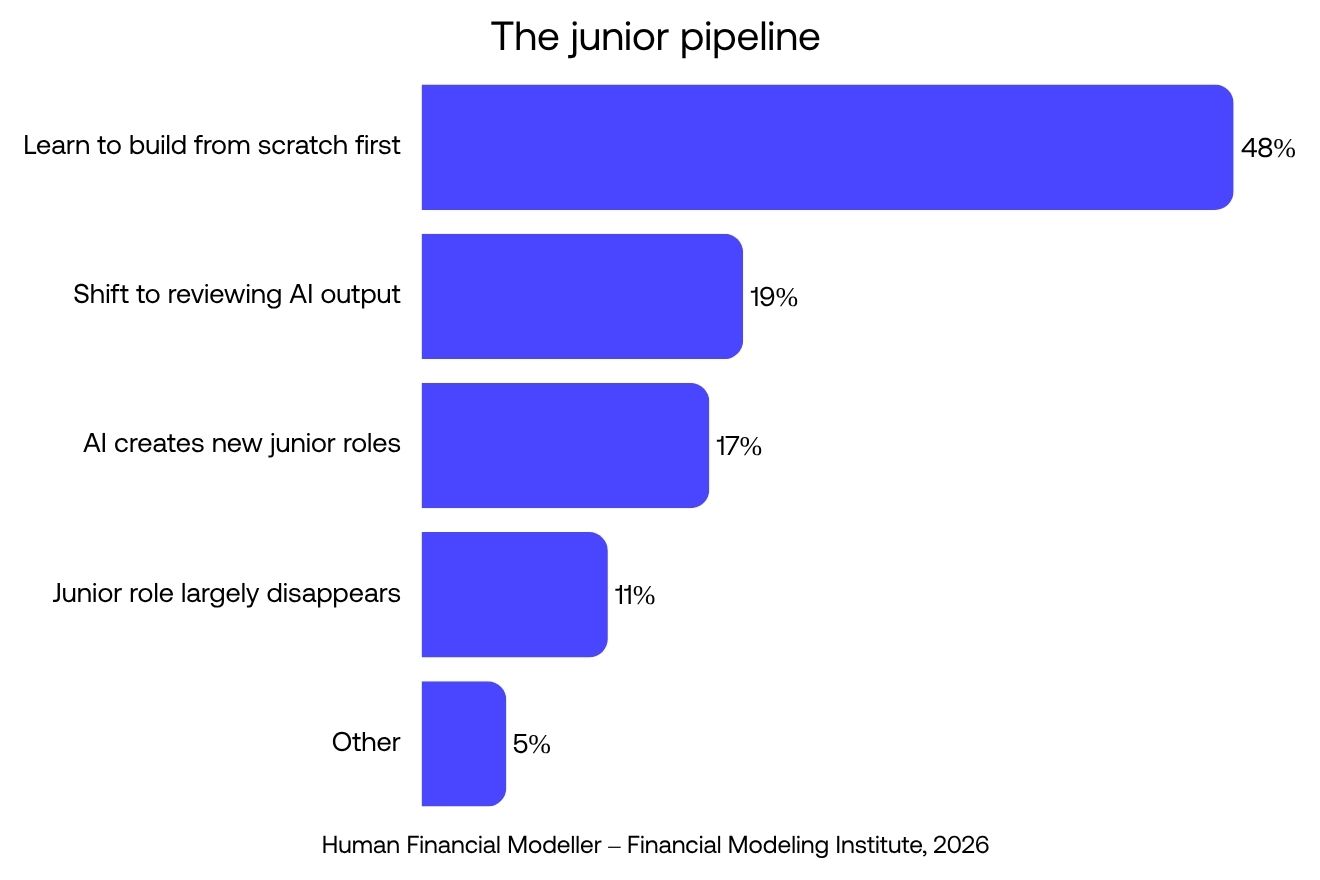
When asked how the profession should train its next generation, 48% of the Council said the traditional path still matters: juniors should learn to build models by hand before being handed AI tools. This is the plurality view, and it's consistent with the 94% who agreed that hand-building knowledge remains essential for developing financial judgment. The argument is developmental, not nostalgic. As the report puts it, you cannot supervise what you do not understand, and you cannot understand what you have never built.
But the Council isn't unified. 19% think training should shift toward reviewing and validating AI output rather than building from scratch, a fundamentally different way of developing a professional. One member drew an analogy to pilots learning on simulators before flying real aircraft. Another 17% expect AI to create entirely new junior roles that don't exist yet. And 11% believe the junior role will largely disappear, which raises the starkest question of all: if AI eliminates the entry-level work that served as the profession's apprenticeship, where will tomorrow's senior professionals be trained?
However that debate resolves, the near-term consequence is the same. The pipeline that reliably produced experienced, judgment-capable finance professionals is being disrupted right now, and no consensus replacement exists. That means proven senior talent, people who already completed the hands-on apprenticeship, becomes more valuable and harder to find. For a finance leader who needs to hire an accountant fast, a tightening supply of already-trained professionals is not a distant concern. It's a present one.
Why Proven Experience Gets Scarcer From Here
The logic compounds. If fewer juniors develop deep, hands-on understanding because AI does the foundational work, then fewer of them mature into the senior professionals who can review AI output and sign off on it with authority. The judgment layer the same survey identified as essential depends on people who learned the craft from the ground up, and that learning path is exactly what's being disrupted.
For companies, this creates a widening gap between the talent they need and the talent the market is producing. You need professionals with real technical depth and seasoned judgment, but the mechanism that used to generate a steady supply of them is faltering. In that environment, the professionals who already have the training and experience become a premium, contested resource. Waiting for the local market to supply them on your timeline becomes riskier, and the pressure to hire an accountant fast collides with a shrinking pool of people who actually fit.
This is where the sourcing strategy has to change. Rather than competing for a dwindling group of locally available, fully-trained professionals, finance leaders are widening the map to reach proven talent wherever it exists. Pre-vetted accounting talent, screened in advance for the technical depth and judgment the role requires, sidesteps the pipeline problem entirely, because the vetting has already happened before the candidate reaches you.
The Answer Is a Bigger, Pre-Screened Pool
The pipeline disruption the FMI Council describes isn't going to resolve quickly. The debate over how to train the next generation will play out over years, and in the meantime the supply of home-grown senior talent stays constrained. Finance leaders who need experienced people can't afford to wait for that to sort itself out.
The practical response is to draw from a wider pool of pre-vetted accounting talent that's already proven. When candidates have been screened for US GAAP fluency, technical depth, and the judgment that comes from real experience, you're not exposed to your local market's pipeline problems. You can hire an accountant fast because the assessment is already done, and you get someone who completed the hands-on apprenticeship the profession worries it's losing. The Council raised a hard question about where future senior talent comes from. The most direct answer available to finance leaders today is to stop limiting the search to one shrinking pipeline and start hiring from a pre-vetted global pool where proven professionals already exist.
As AI takes over the entry-level work that traditionally trained junior finance professionals, the profession faces a question about how the next generation will develop the deep understanding needed to become senior talent. The FMI Global Leaders Council is divided on the answer, and that uncertainty signals a tightening future supply of experienced professionals.
What did the FMI survey say about training juniors?
48% of the Council said juniors should still learn to build models by hand before using AI, consistent with the 94% who called hand-building knowledge essential to financial judgment. Meanwhile 19% favored shifting toward reviewing AI output, 17% expected new junior roles to emerge, and 11% believed the junior role will largely disappear.
Why does this make experienced finance talent scarcer?
If fewer juniors develop hands-on understanding because AI does the foundational work, fewer will mature into senior professionals capable of reviewing and signing off on AI output. That constrains the future supply of the very judgment-capable talent companies most need, making proven professionals a more contested resource.
How can companies hire an accountant fast despite the shortage?
By drawing from a pre-vetted global pool rather than a shrinking local one. Pre-vetted accounting talent has already been screened for technical depth and judgment, so companies can hire an accountant fast without waiting on a local pipeline that's being disrupted by AI.
What is pre-vetted accounting talent?
Pre-vetted accounting talent refers to professionals who have been screened in advance for qualifications like US GAAP proficiency, ERP experience, and demonstrated judgment before being presented to an employer. This removes the sifting and uncertainty of a traditional search and gives finance leaders access to proven people quickly.