Zero Out of 63 Finance Experts Would Trust an AI Model Without Human Review
A survey of 63 elite financial modellers found unanimous agreement that AI models need human review. Here's what it means for staffing your finance team with high-quality finance talent.
Written by
MAVI
Published On
September 2, 2026
When a survey asks 30 questions to 63 of the world's most experienced financial modellers, you expect disagreement. On most questions, that's exactly what the Financial Modeling Institute found. But on one statement, the Global Leaders Council was completely united, and the result is worth every finance leader's attention: not a single member agreed they would trust an AI-generated model for a high-stakes decision without independent human review.
Zero out of 63. In a group spanning 26 countries and five continents, 75% strongly disagreed, 22% disagreed, 3% were neutral, and no one agreed. That kind of unanimity almost never happens in expert surveys. It tells you something the general AI-hype cycle keeps missing: the people who understand financial models best do not trust them without a human standing behind the output.
The Strongest Consensus in the Entire Study
The statement put to the Council was simple: "I would feel confident relying on an AI-generated financial model for a high-stakes business decision without any independent human review." The total absence of agreement is the headline, but the comments behind it are what matter for anyone building a finance team.
Members didn't frame their disagreement as a temporary limitation of today's tools. They framed it as a matter of principle. One compared trusting an unreviewed AI model to relying on work from someone with a single day of training. Another said that even as AI-assisted modelling matures, they would still disagree. A third put it bluntly: a leader who relied on a knowingly under-reviewed model would be negligent.
The through-line is that accuracy alone doesn't create trust. A model can be right and still be unusable if no qualified person has examined the logic, pressure-tested the assumptions, and taken responsibility for what it says. That review layer is human, and it doesn't get cheaper or less necessary as the models improve. If anything, more AI output means more review work, which means the real bottleneck becomes having enough high-quality finance talent to do it.
Sign-Off Is Seen as Permanently Human
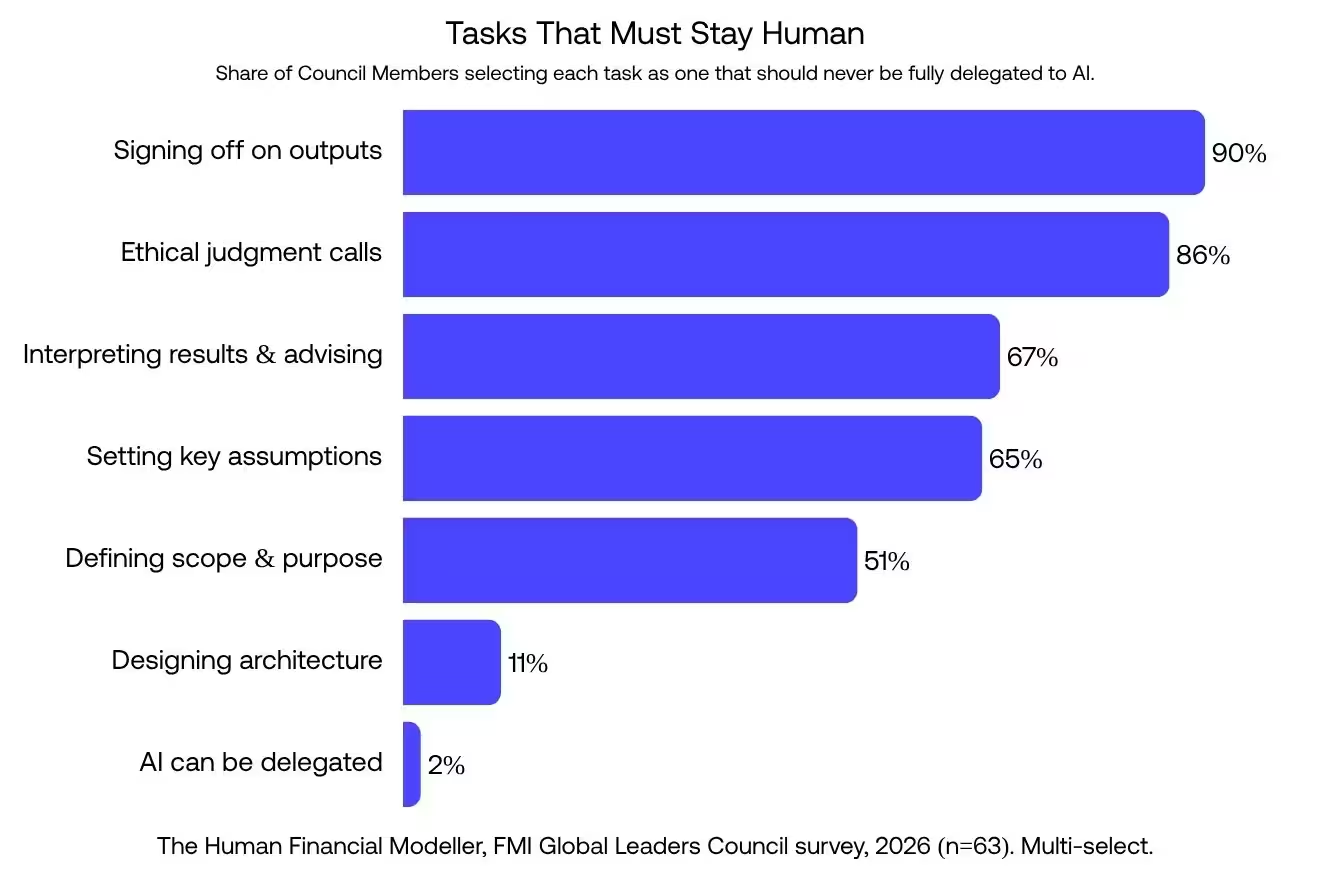
The unanimous review finding wasn't a one-off. When the Council was asked which tasks should never be fully delegated to AI, signing off on model outputs topped the list at 90%. Ethical judgment calls followed at 86%. These are the acts of putting professional judgment behind a number and answering for it, and the profession sees them as fundamentally, permanently human.
This matters because sign-off is where accountability lives. No matter how capable a model becomes, someone has to be able to tell the auditor, the board, or the lender why the number is the number, and to carry the consequences if it's wrong. A machine can generate the figure. It cannot own it. That ownership requires a person with the technical depth to understand what they're approving, which is a very specific and increasingly valuable kind of hire.
For finance leaders, the practical read is that automation doesn't reduce your need for capable people. It concentrates that need at the review-and-sign-off layer, where judgment and accountability can't be delegated to software. A team without enough high-quality finance talent at that layer isn't saving money by leaning on AI. It's accumulating unreviewed risk.
Why This Reshapes How You Staff a Finance Team
Put the two findings together and a staffing conclusion emerges. AI can accelerate the production of financial work, but every output still needs a qualified human to review it and sign off. The more you automate, the more that review capacity becomes your constraint. And the professionals who can perform it, people who can trace a model's logic, catch what's wrong, and stand behind the result, are exactly the profile that's hardest to find and slowest to hire through conventional channels.
This is why more finance leaders are widening where they look. When the binding constraint is qualified review capacity rather than raw processing, the answer is to build a bench of proven professionals who can supervise AI-assisted work with confidence. Being willing to hire a remote accountant rather than restricting the search to your local market dramatically expands the pool of people who can fill that review-and-sign-off role, and it does so without the cost or timeline of a conventional search.
Sourcing pre-vetted, globally sourced professionals lets you put high-quality finance talent in exactly the seats the FMI data says matter most: the ones where a human reviews the output and takes responsibility for it. When you can hire a remote accountant with genuine US GAAP depth and the judgment to catch what AI misses, you get the productivity of automation without the exposure of trusting it blind. The 63 experts were unanimous that human review is non-negotiable. The strategic question for finance leaders is simply whether they have enough of the right people to provide it.
What did the FMI survey find about trusting AI financial models?
The Financial Modeling Institute's Global Leaders Council, made up of 63 senior modellers across 26 countries, was asked whether they'd trust an AI-generated model for a high-stakes decision without human review. Not one agreed. 75% strongly disagreed and 22% disagreed, making it the single strongest consensus in the entire 30-question survey.
Does this mean AI has no place in financial modelling?
No. The Council uses AI widely for tasks like formula writing and data preparation. The point is that AI output requires independent human review before it can be trusted for consequential decisions. AI accelerates the work, but a qualified person must still validate and sign off on it.
Why is human sign-off considered so important?
Sign-off is where accountability lives. 90% of the Council said signing off on model outputs should never be fully delegated to AI. Someone has to be able to explain and defend a number to auditors, boards, and lenders, and take responsibility if it's wrong, which is a fundamentally human function.
How does this affect finance hiring?
Since every AI output needs qualified human review, the review-and-sign-off layer becomes the constraint as automation grows. That raises demand for high-quality finance talent who can supervise AI-assisted work, and makes the ability to hire a remote accountant with real technical depth a meaningful advantage.
Is it practical to hire a remote accountant for this kind of work?
Yes. Reviewing and signing off on financial work can be done by a qualified professional regardless of location. Choosing to hire a remote accountant widens the talent pool well beyond the local market, giving finance leaders access to pre-vetted professionals with the US GAAP depth and judgment the review layer requires.