How to Cut a 20-Day Close to 7 Without Hiring a Full-Time US Controller
How to cut a 20-day month-end close to 7 days without a full-time US controller: the close calendar, earlier reconciliations, clear ownership and review.
Written by
MAVI
Published On
November 23, 2026
To cut a 20-day month-end close to 7, move reconciliations into the month, set firm cutoffs, give every close task a named owner and deadline, and add review capacity so work never waits on one person. A senior accountant who owns the close calendar can drive most of this without a full-time US Controller.
Seven days is a realistic target. Ventana Research found 59% of organizations close their monthly books within six business days, a share that has barely moved since 2019 (Ventana Research, 2023).
Key Takeaways
Most of a long month-end close is waiting, for cutoffs, reconciliations and reviews.
Reconcile during the month so close week is for review and adjustments.
A written close calendar with owners removes most of the delay.
Added review capacity can come from a senior accountant or global Controller instead of a US hire.
Why Closes Stretch to 20 Days
A 20-day close is rarely 20 days of work. Most of the time goes to waiting for bank statements, vendor invoices, payroll reports, approvals and one person's review. Reconciliations that start after month-end and tasks that only one person knows how to do push the timeline further. When that person leaves, see how to replace a Controller who resigns before month-end.
Our month-end close statistics show how common long closes are and what separates fast teams from slow ones.
Step 1: Map the Current Close
List every task in the current close with its owner, start day, finish day and dependencies. Most teams find a handful of tasks on the critical path, such as bank reconciliations, AP accruals, revenue and the balance sheet review, while everything else could run in parallel.
Step 2: Move Reconciliations Into the Month
Reconcile bank, credit card and high-volume accounts weekly instead of once after month-end. By close week, only the final days of activity remain, which turns a multi-day task into a few hours.
Technology helps here. Ventana found 50% of organizations with mostly automated reconciliations close their quarter within six business days, compared with 33% of those with little or no reconciliation automation.
Step 3: Set Firm Cutoffs
Agree on cutoff dates with every team that feeds the close. AP stops accepting prior-month invoices on day one, sales confirms billing by day one, and payroll and expense reports are final by day two. Items that arrive later are accrued and trued up next month.
Step 4: Publish a Seven-Day Close Calendar
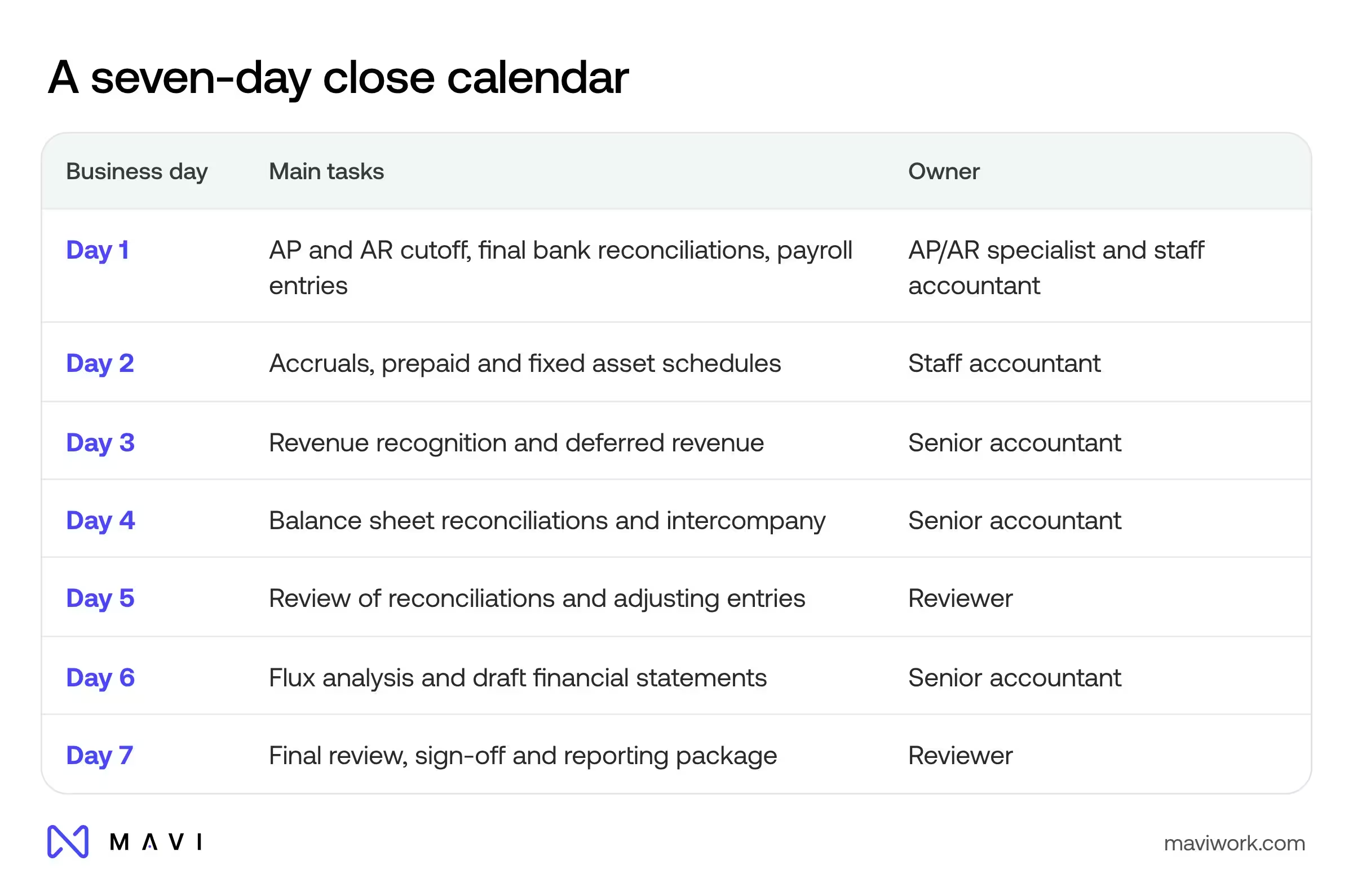
A close calendar turns the plan into deadlines. The example below fits a company with a senior accountant, a staff accountant and an AP/AR specialist.
Step 5: Add Review Capacity Without a Full-Time US Controller
Reviews are the most common bottleneck once tasks are on schedule. A senior accountant can review staff work daily during close, leaving final sign-off to the CFO, an outside CPA or a part-time US finance leader.
Recurring journal entries, standard accruals and bank feeds should run from templates or ERP automation. Teams on NetSuite can often remove days by configuring recurring entries and reconciliation matching properly. Our guide to the best places to hire NetSuite accountants covers where to find that experience.
The payoff is significant. The Hackett Group found that world-class finance teams close their books 35% to 57% faster than peers (Hackett Group, 2025).
Step 7: Measure Every Close
Track the length of every month-end close, the number of late tasks and the number of post-close adjustments after every cycle. Review the results with the team within a week and fix the slowest step first. Expect it to take several close cycles before the new calendar holds.
Build a Faster Close With MAVI
MAVI places pre-vetted global senior accountants, staff accountants and Controllers who own close tasks inside your ERP, typically in as fast as 5 days. Companies save 50%+ compared with equivalent US hiring and start with a 14-day risk-free trial.
See how it works to learn how MAVI matches talent to your systems, hours and close calendar.
Many companies target five to seven business days. Ventana Research found 59% of organizations close their monthly books within six business days.
What slows down the month-end close most?
Common causes are reconciliations left until after month-end, late AP and AR cutoffs, manual journal entries, unclear task ownership and reviews that wait on one person.
Do I need a full-time US controller to close faster?
Not necessarily. A senior accountant who owns the close calendar, supported by staff who reconcile accounts during the month, can shorten the close significantly. A CFO, outside CPA or global Controller can provide final review.
How long does it take to cut the close from 20 days to 7?
It usually takes several close cycles. Clear ownership and earlier reconciliations tend to remove days first, and templates and automation add further gains over later closes.