How to Convert From Cash to Accrual After a PE Buyout Without Adding US Headcount
How to convert from cash to accrual after a PE buyout in about 90 days, what changes in the books and how to staff it without adding US headcount.
Written by
MAVI
Published On
November 9, 2026
A cash to accrual conversion after a PE buyout usually takes about 90 days. The finance team restates opening balances for receivables, payables, accruals and deferred revenue, rebuilds the close around accrual entries, and runs two full closes before reporting to the sponsor. One dedicated global senior accountant can carry most of the work without a new US hire.
Many founder-led companies run their books on a cash basis for years because it is simple and works for taxes. A PE buyout changes the audience. The sponsor, the lender and the auditor all need financial statements that match revenue to the period it was earned, and they need them every month.
Key Takeaways
PE owners need accrual books for monthly reporting, covenant tests and the audit, usually within weeks of closing.
The conversion touches five areas: receivables, payables and accruals, deferred revenue, prepaids and inventory.
A 90-day plan works for most acquired companies, split into assessment, conversion and two parallel closes.
Book and tax methods are separate decisions, and a tax change runs through IRS Form 3115.
A dedicated global senior accountant can own the conversion while the controller keeps the close on schedule.
Why PE Owners Require Accrual Accounting
Sponsors manage portfolio companies on monthly numbers. They typically expect the board package within 10 to 15 business days of month-end, weekly cash reporting and covenant reporting on the schedule set by the credit agreement (Consero Global, 2026). Cash-basis statements can't support EBITDA, margin or working capital analysis, because revenue and costs land in the month cash moves.
The audit raises the stakes further. Lenders and auditors typically expect GAAP financial statements, and GAAP is built on accrual accounting. Converting before the first audit avoids a year-end scramble to restate twelve months of activity.
Tax rules can force the issue too. For 2026, C corporations and partnerships with a C corporation partner generally can't use the cash method for tax once average annual gross receipts over the prior three years exceed $32 million (IRS, 2025). Add-on acquisitions can push a portfolio company past that line quickly.
What Changes in the Books
A change in accounting basis touches more than one account, and advisory firm Riveron recommends a dedicated project team that understands the differences between the two methods (Riveron, 2025). The table below shows the five areas that change most.
A 90-Day Cash to Accrual Plan
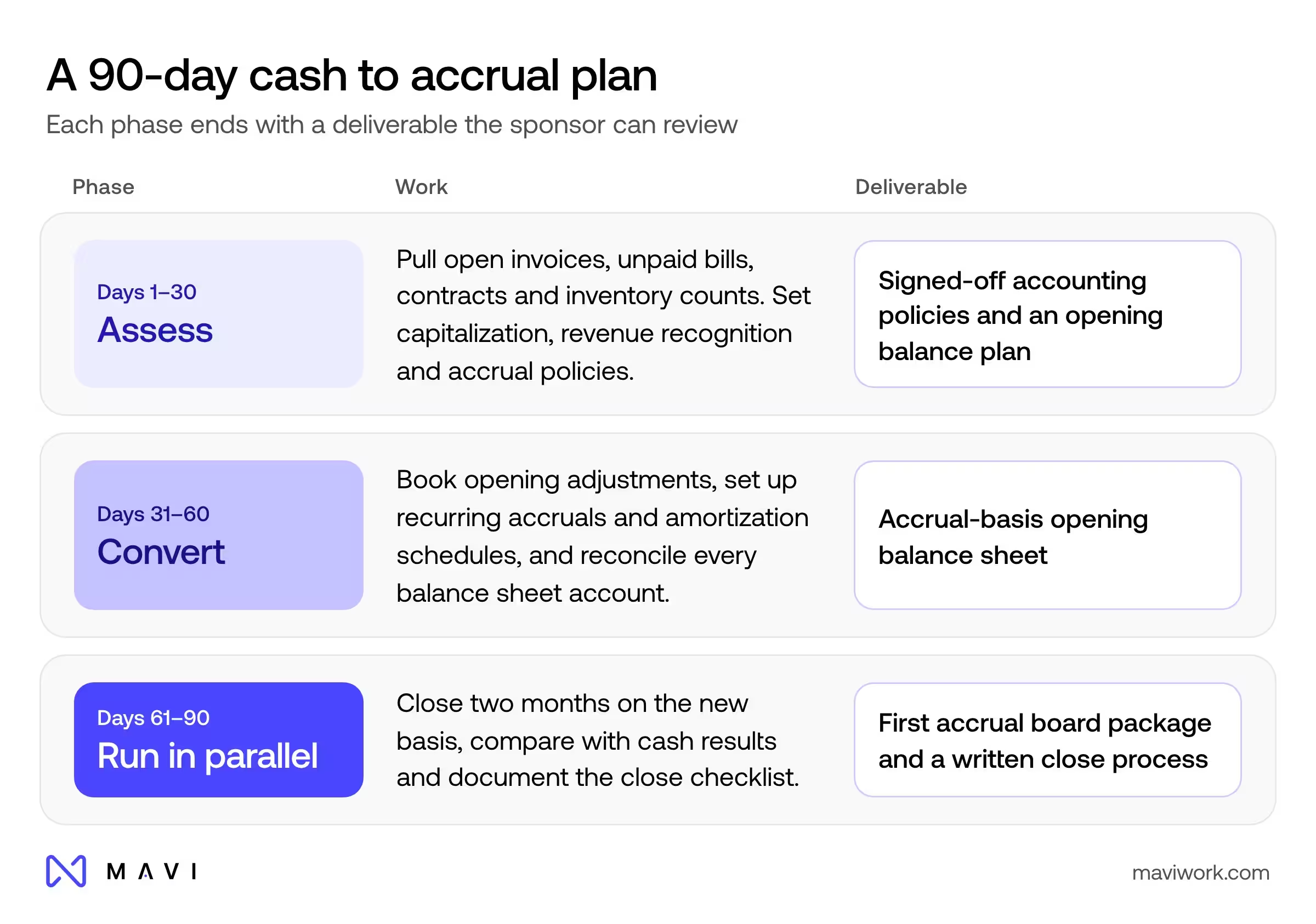
The plan below assumes a conversion date at the start of a month and a controller who stays focused on the current close. Each phase ends with a deliverable the sponsor can review.
Keep the cash-basis view alongside the new numbers for the first two closes. It lets the sponsor see why reported earnings moved, and it gives the auditor a clean bridge between the two methods.
Handle the Tax Side Separately
Book and tax methods are separate decisions. When a company changes its tax method, it requests the change on IRS Form 3115, and a positive section 481(a) adjustment is generally spread over four years (Ambrook, 2026).
Bring the tax advisor in during the assessment phase. The timing of the tax change can affect the deal model, and the advisor will want the same opening balances the finance team builds for the books.
Who Does the Work Without Adding US Headcount
The conversion is concentrated, detailed work that lands on top of a normal close. Pulling the controller onto it puts the close at risk, while a temporary consultant leaves once the opening balances are booked and takes the knowledge with them.
A dedicated senior accountant with GAAP and accrual experience can own the opening balances, the reconciliations and the new close checklist, then stay on to run the recurring accruals. The controller reviews the judgment areas, such as revenue recognition and reserves, and the sponsor gets one person accountable for the numbers.
MAVI places pre-vetted global senior accountants and AP/AR specialists with PE-backed companies, typically in as fast as 5 days. Each engagement starts with a 14-day risk-free trial and a single monthly fee, and companies typically save 50%+ compared with an equivalent US hire.
Accrual books add entries to every close, so the checklist matters more after conversion than before. Investor-backed companies are getting faster: 65% of investor-backed CFOs now finish month-end close within nine days, up from 62% a year earlier (Consero Global, 2026).
Automate recurring accruals and amortization in the ERP, assign every balance sheet account an owner and a reviewer, and track close tasks against due dates. Our month-end close statistics show how top-performing teams structure the close.
Add the Accrual Expertise Your Sponsor Expects
A PE buyout doesn't have to mean a new US hire for the finance team. A dedicated global senior accountant can lead the cash to accrual conversion, keep the portfolio company on its reporting calendar and stay on to run the accrual close every month.
How long does a cash to accrual conversion take after a PE buyout?
Most portfolio companies can complete a cash to accrual conversion in about 90 days: 30 days to assess balances and policies, 30 days to book opening entries and reconcile, and 30 days to run the first full accrual closes. Complex revenue or inventory can extend the timeline.
Do I need to change my tax method when I convert books to accrual?
Not always. Book and tax methods can differ, but C corporations and partnerships with a C corporation partner generally lose access to the cash method once average annual gross receipts exceed $32 million for 2026. A tax method change is requested on IRS Form 3115, so work through it with your tax advisor.
Who should do the conversion work?
A senior accountant with accrual and GAAP experience should own the opening balance work and the new close checklist, with the controller or CFO reviewing judgment areas. Many portfolio companies add a dedicated global senior accountant for this instead of a new US hire.
What accounts change the most in a cash to accrual conversion?
Accounts receivable, accounts payable and accrued expenses, deferred revenue, prepaid expenses and inventory change the most, because each records revenue or cost in the period it was earned or incurred rather than when cash moved.