18 Finance Team Size Benchmarks by Company Revenue in 2026
18 finance team size benchmarks by company revenue and headcount, from startup finance ratios to finance FTEs per $1B in revenue.
Written by
MAVI
Published On
November 13, 2026


Finance team size grows with revenue, but not in a straight line. Venture-backed companies with 51–250 employees average about five finance staff, or 3.5% of headcount, while large enterprises run a median of 65 finance FTEs per $1 billion of revenue (Aleph, 2025).
The benchmarks below cover startups, growth-stage companies and large enterprises, with a revenue-band estimate to help finance leaders plan their next hires.
Key Takeaways
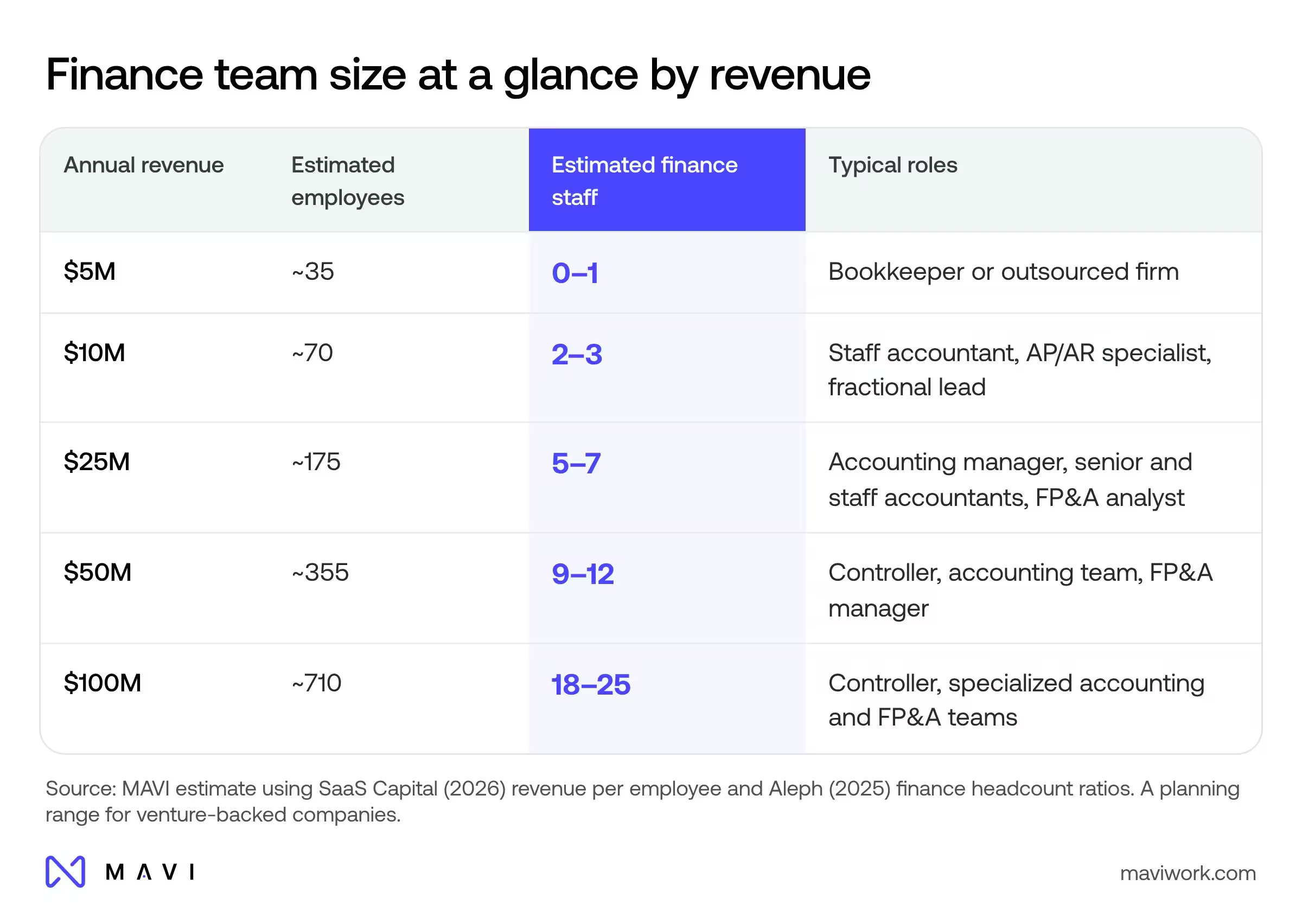
MAVI estimated typical finance headcount at each revenue band by combining SaaS Capital's revenue per employee figures with Aleph's finance-to-headcount ratios. Treat it as a planning range for venture-backed companies, since lean or services-heavy businesses will differ.
Aleph studied the finance teams of 218 B2B companies that went through Y Combinator between 2015 and 2025. Its data shows how finance headcount builds as a company grows.
At this stage, finance is usually one part-time person or an outside firm. Finance makes up about 1.3% of headcount (Aleph, 2025).
The rest rely on founders, bookkeepers or outsourced accounting until the books become too complex to manage part-time.
Finance rises to about 3.5% of headcount as companies hire their first dedicated accountants and an FP&A lead (Aleph, 2025).
The share of headcount dips to about 2.9%, since the finance team scales more slowly than sales and engineering once processes are in place.
At this size, finance splits into specialized accounting, FP&A, tax and treasury teams (Aleph, 2025).
Accounting headcount still outnumbers FP&A at every stage. Companies that need forecasting first can start with an FP&A manager and add accounting depth later.
Revenue per employee connects headcount to revenue, which makes it the bridge between finance team size and company revenue. SaaS Capital surveyed more than 1,000 private SaaS companies for its 2026 benchmarks (SaaS Capital, 2026).
Measured as ARR per full-time employee, this figure gives a quick way to estimate total headcount at a given revenue level.
Revenue per employee rises with scale, since fixed functions such as finance spread across more revenue (SaaS Capital, 2026).
Early-stage companies carry more headcount relative to revenue, which is one reason many delay a full-time finance hire.
APQC benchmarks, cited in ScottMadden's 2024 study of 103 shared service organizations at companies above $1 billion in revenue, show how lean mature finance functions run (ScottMadden, 2024).
That ratio reflects decades of process standardization, shared services and automation.
The gap between quartiles is three to one, which shows how much process design affects finance headcount (ScottMadden, 2024).
These organizations combine shared services, standardized processes and heavy automation.
That is just under 1% of revenue. Top-quartile organizations spend $6.64 or less, while bottom-quartile organizations spend $16.66 or more (ScottMadden, 2024).
The Hackett Group found that its digital world-class finance teams operate with far fewer staff than their peers (Hackett Group, 2025).
Lower headcount and better processes combine to cut cost while still delivering faster reporting.
Faster close cycles free time for analysis. Our month-end close statistics show where most teams stand today.
Gartner's survey of 420 companies found that people account for most of finance spending (Gartner, 2022). Hiring choices therefore shape the finance budget more than software does.
Their finance spend relative to revenue is at least twice that of food and beverage companies, largely because of complex revenue recognition and fast growth.
Benchmarks set a range, and the right finance headcount depends on transaction volume, revenue complexity, entity count and audit requirements. A SaaS company with usage pricing and three entities will need more finance staff than a single-product business at the same revenue.
The first dedicated hire is usually an accountant who owns reconciliations and the close. A staff accountant is the common starting point.
An accounting manager usually follows, and later a Controller as the team grows past five or six people.
Many growing companies now fill those seats with global talent. Our remote finance team statistics cover how that model is spreading.
MAVI places pre-vetted global finance and accounting professionals, from staff accountants to Controllers, typically in as fast as 5 days. Companies save 50%+ compared with equivalent US hiring and start every engagement with a 14-day risk-free trial.
A venture-backed company at about $10M in revenue typically has around 70 employees and two to three finance staff, based on MAVI's estimate from Aleph and SaaS Capital benchmarks. That usually means a senior or staff accountant, an AP/AR specialist and a part-time or fractional finance lead.
Among Y Combinator B2B companies studied by Aleph, finance made up 1.3% of headcount at 5–50 employees, 3.5% at 51–250 employees and 2.9% at 251–500 employees.
APQC data cited by ScottMadden puts the median at 65 finance FTEs per $1 billion of revenue, with top-quartile organizations at 33 and bottom-quartile organizations at 100.
Most startups build accounting first, but Aleph found that more than 20% of companies hired FP&A before a Controller. The right order depends on whether the bigger gap is clean books or forecasting.