What Is the Difference Between Staff Augmentation and Outsourcing?
Staff augmentation adds people your team directs; outsourcing hands a function to a provider. Compare control, cost and fit for finance and accounting.
Written by
MAVI
Published On
November 13, 2026
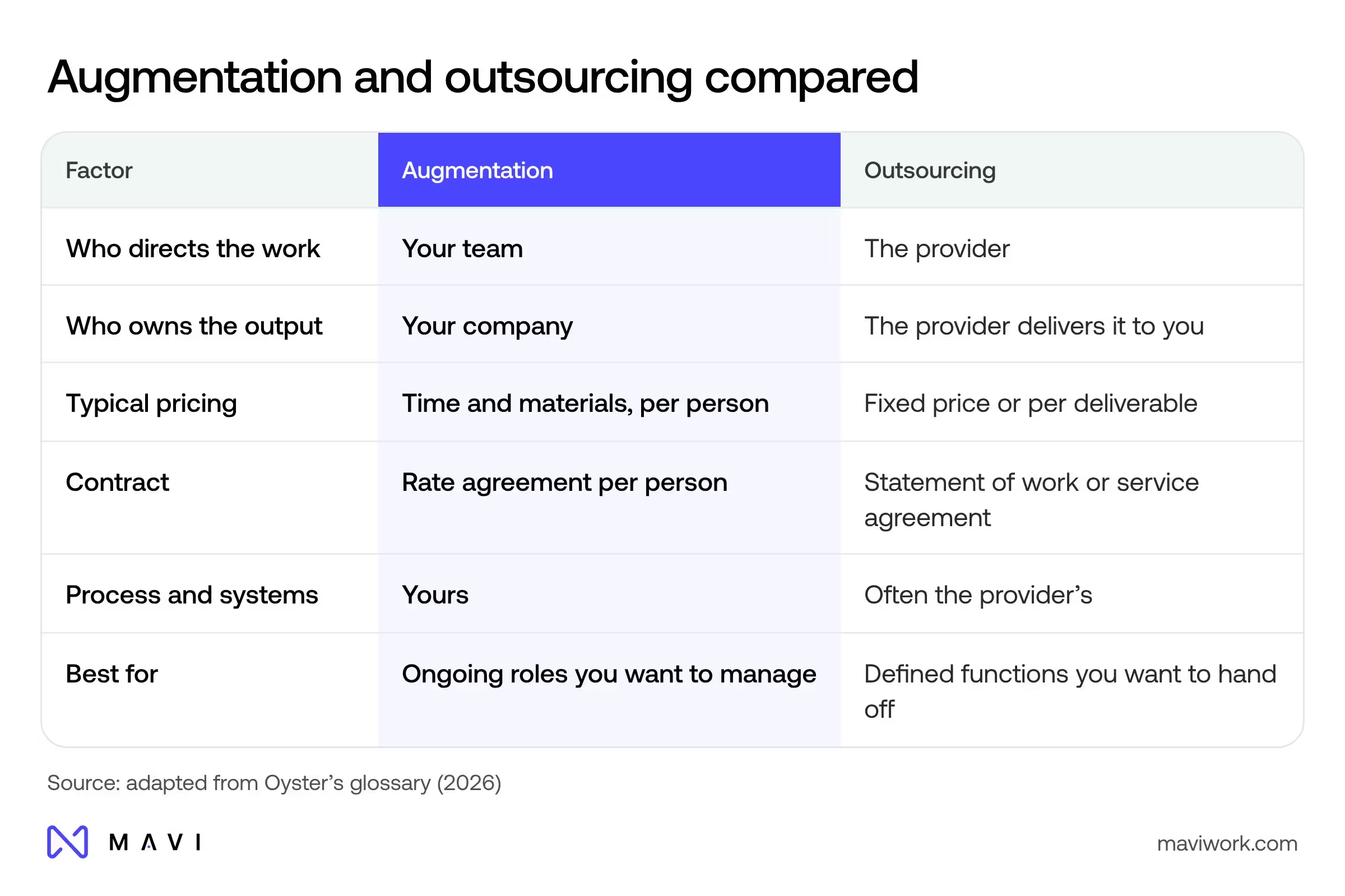
The difference between staff augmentation and outsourcing is who controls the work. Augmentation adds people who work under your direction, in your systems, while you own the result. Outsourcing hands a defined function or project to a provider, which manages the people and delivers an agreed outcome.
For finance teams, the choice decides who runs the close, who owns the controls and how much knowledge stays inside the company.
Augmentation and Outsourcing Compared
How Does Staff Augmentation Work?
A provider supplies skilled people who join your team for a period of time or on an ongoing basis. They follow your processes, attend your meetings and report to your managers, and you pay for their time. The provider handles recruiting, contracts and payment.
How Does Outsourcing Work?
The provider agrees to deliver a function or project, usually under a statement of work with defined scope, service levels and price. It decides who does the work and how. Larger engagements are often structured as managed services, where the provider runs an entire process on an ongoing basis.
Which Model Are Companies Choosing?
Deloitte's 2024 Global Outsourcing Survey of more than 500 leaders found that 67% of organizations have adopted managed services, up from 45%, while 29% still use staff augmentation (Deloitte, 2024).
The same survey found that access to talent is now the top reason to outsource, cited by 42% of leaders. Cost reduction was a primary driver for only 34%, down from 70% in 2020.
Control remains a concern. Seventy percent of organizations brought some previously outsourced work back in-house over the past five years, even as 40% expect their outsourcing investment to grow.
Which Model Fits Finance and Accounting?
Outsourcing suits functions with clear boundaries and little company-specific judgment, such as payroll processing or annual tax filings. A statement of work can define the deliverable, and the provider's process works well enough.
Augmentation suits work that depends on your ERP, your revenue rules and your close calendar. Reconciliations, accruals and month-end close tasks benefit from someone who learns one company in depth and stays on the seat.
Temporary staffing sits between the two, with short-term people placed by an agency. Our MAVI vs Temp Staffing comparison covers when each model fits.
What Are the Risks of Each Model?
Outsourcing carries scope risk. Anything outside the statement of work becomes a change order, and knowledge of your processes sits with the provider. Under managed services, switching providers later can mean a long and costly transition.
Augmentation carries management risk. Your team must onboard, direct and review the work, so the model pays off only when someone in-house has time to lead it. Turnover matters too, since knowledge leaves with each person who rolls off.
Where Does a Dedicated Global Hire Fit?
A dedicated global hire is a form of staff augmentation built for continuity. The professional works full-time inside your systems and reports to your team, while the provider handles sourcing, vetting and the engagement. Our offshore accounting statistics show how widely finance teams now use this model.
MAVI places top-2% vetted global finance professionals as dedicated team members, typically in as fast as 5 days. Companies keep full control of the work, save 50%+ compared with equivalent US hiring and start with a 14-day risk-free trial.
See how it works for the full process, from matching to the first day on your team.
What is the main difference between staff augmentation and outsourcing?
The main difference is control. With augmentation, the company directs the work and owns the output while the provider supplies the people. With outsourcing, the provider takes responsibility for delivering a defined function or result.
Is staff augmentation cheaper than outsourcing?
It depends on the scope. Augmentation is usually billed per person over time, while outsourcing is often priced by project or deliverable. Ongoing work with steady volume is often cheaper with a dedicated augmented hire.
Which model is better for accounting?
Companies that want to keep their close process, ERP and controls in-house usually prefer augmentation or a dedicated hire. Companies that want to hand off a whole function, such as payroll or tax filings, often outsource it.
Can a company use both models?
Yes. Many finance teams outsource payroll or tax filings under managed services while augmenting the core accounting team with dedicated staff who run the close.
How long do augmentation engagements last?
They range from a few weeks for a project to several years for an ongoing role. Dedicated hires for core accounting work usually run open-ended, with notice periods set in the agreement.