How to Trial a Remote Accountant for Two Weeks Before Committing
How to trial a remote accountant for two weeks before committing: what to set up, the work to assign each week, the scorecard to use and the red flags to watch.
Written by
MAVI
Published On
November 13, 2026
To trial a remote accountant for two weeks, set clear success criteria before day one, give them real work with deadlines, and review their output against a written scorecard at the end of each week. Use the first week for reconciliations and the second for close tasks, then decide on day 14.
A trial costs far less than a wrong hire. Gallup estimates that replacing an employee costs between half and two times their annual salary (Gallup, 2019), and the next search adds weeks to an already stretched close calendar.
Key Takeaways
Define success before the trial starts, with a scorecard the accountant sees on day one.
Use real work, since sample tests can't show how someone handles your systems and your deadlines.
Week one tests accuracy; week two tests close readiness and independent judgment.
Decide on day 14, and don't extend a trial to avoid a hard conversation.
Why a Trial Beats Another Interview Round
Interviews show how candidates talk about accounting. A trial shows how they do it in your ERP, with your chart of accounts and your team. It also saves time, since SHRM puts the median time to fill a nonexecutive role at 39 days (SHRM, 2026).
Our time-to-hire statistics show how long a restarted search can take. A two-week trial on real work replaces several rounds of hypothetical questions with evidence.
Set Up the Trial Before Day One
Prepare access, documentation and a reviewer before the start date. The accountant needs read and write access to the ERP, the bank feeds and the shared close checklist, plus a short written guide to your chart of accounts and approval rules.
Assign one reviewer who will check every deliverable within a day. Feedback that arrives late leaves the remote accountant guessing, and it makes the final decision harder to defend.
Share the scorecard on the first morning. Candidates perform better when they know how they will be judged, and the decision at the end becomes a review of evidence instead of a feeling.
Use a Simple Scorecard
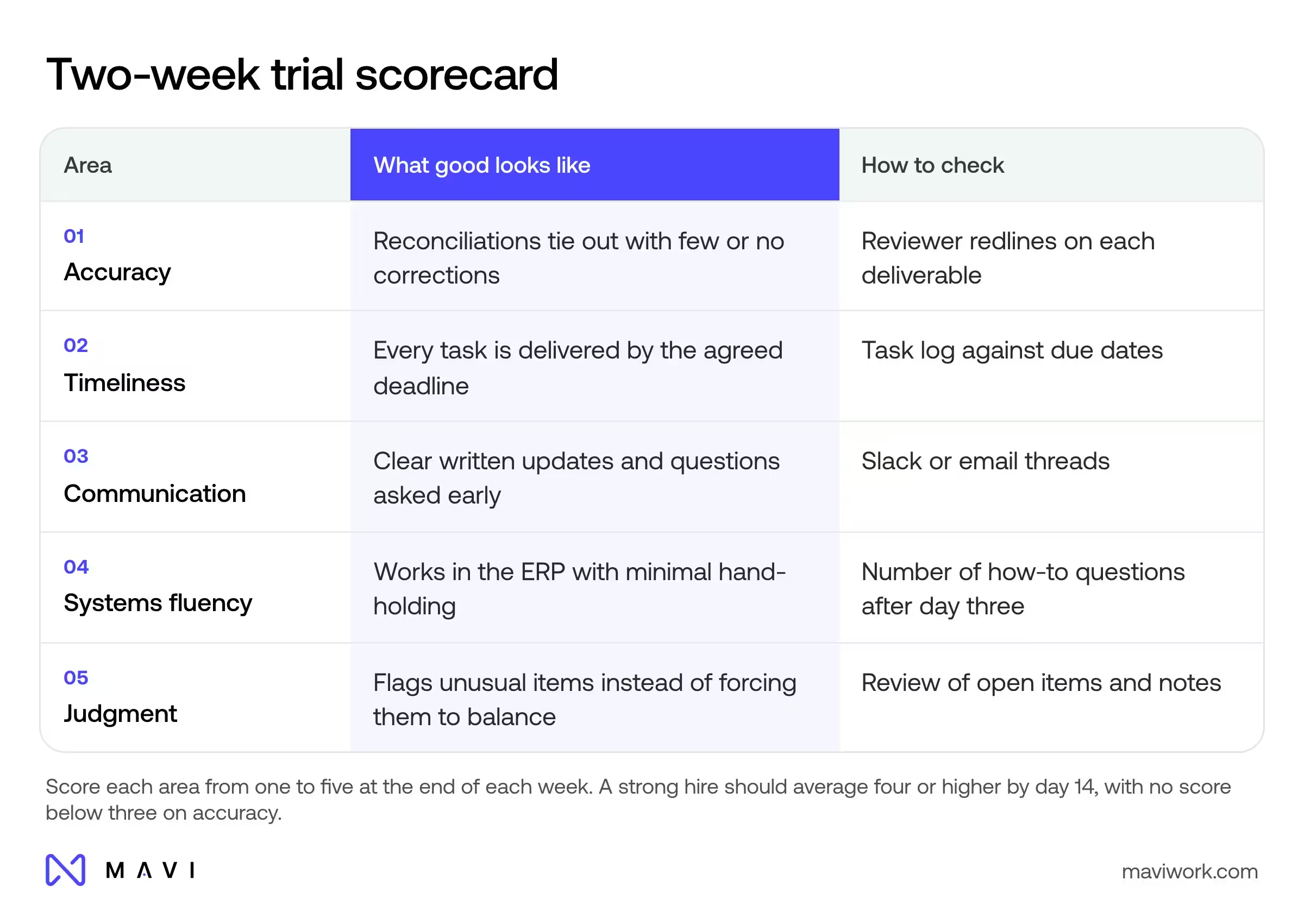
Score each area from one to five at the end of each week. A strong hire should average four or higher by day 14, with no score below three on accuracy.
Week One: Test Accuracy on Real Work
Start with work that has a clear right answer. Bank and credit card reconciliations for the prior month, a batch of AP invoices and one balance sheet account reconciliation give the reviewer objective output to check.
Watch how the accountant handles what doesn't tie. A strong candidate documents the variance, proposes an explanation and asks a specific question. A weak one forces a plug entry or stays silent until the deadline.
End the week with a 30-minute review against the scorecard. Share the scores and the reasons, so the second week tests whether the accountant takes feedback.
Week Two: Test Close Readiness
In the second week, assign tasks from the month-end close: accruals, prepaid and fixed asset schedules, and a first draft of variance commentary. These tasks require judgment as well as accuracy, which shows whether the remote accountant can work independently.
Give at least one task with a tight deadline that overlaps with US working hours. Reliability under close-week pressure is the best predictor of how the role will run after the two-week trial.
Red Flags to Watch For
The most serious warning signs are repeated errors on corrected work, deadlines missed without notice and entries that balance without support. Any one of these should weigh heavily on the decision, because each will cost reviewer time every month.
Slow ramp-up on your ERP is less serious, especially in the first few days. Look for a clear trend toward fewer questions by the end of week one.
Make the Decision on Day 14
Review the two weekly scorecards with the reviewer and decide on the agreed date. A candidate who averages four or more and improved after feedback is ready to commit to. Extending a weak trial rarely changes the outcome and delays the search for a better fit.
Where to Find Remote Accountants With a Built-In Trial
Some talent providers build a trial into the engagement. Toptal offers a two-week trial period across its finance talent (Toptal, 2026).
Our MAVI vs Toptal comparison covers how the two models differ on vetting, cost and commitment.
MAVI includes a 14-day risk-free trial in every engagement. Candidates arrive after passing MAVI's vetting process, which tests technical accounting, ERP fluency and written communication, so the trial confirms fit instead of screening basics.
Companies receive two vetted profiles per role, start in as fast as 5 days and work with a minimum 50% overlap with US hours. See how it works for the full process.
Start a 14-Day Risk-Free Trial With MAVI
MAVI places top-2% vetted global accountants who join your team as dedicated members. Companies typically save 50%+ compared with equivalent US hiring, with no placement fee and a single monthly fee.
Is a two-week trial long enough to judge an accountant?
Two weeks is enough to see technical accuracy, communication and reliability, especially when the trial includes a week of real reconciliations and part of a month-end close. Judgment on complex areas such as revenue recognition can take longer to confirm.
Should I pay a remote accountant during a trial?
Yes. A paid trial on real work attracts stronger candidates and gives a truer picture of performance. Some providers, including MAVI, offer a risk-free trial period as part of the engagement.
What work should a remote accountant do in a two-week trial?
Good trial work includes bank and credit card reconciliations, AP processing, a balance sheet reconciliation and support on month-end close tasks. Each task should have a clear deadline and a reviewer.
What if the trial doesn't work out?
End it on the agreed date and share specific feedback. Providers that offer a trial usually present a replacement candidate quickly, so the search doesn't start from zero.