How to Hire a Revenue Accountant Who Already Knows ASC 606
How to hire a revenue accountant who already knows ASC 606: the skills to screen for, a practical contract test, the tools that matter and where to find them.
Written by
MAVI
Published On
November 10, 2026
To hire a revenue accountant who already knows ASC 606, screen for hands-on work across all five steps of the standard, test candidates on a real multi-element contract, and confirm they have run revenue schedules in your ERP. The fastest route is a pre-vetted talent source that tests technical accounting before you interview.
Revenue recognition is where growing companies most often outgrow a generalist. Once contracts bundle subscriptions, implementation, usage pricing and discounts, the monthly revenue number depends on judgment, and auditors will test every one of those judgments.
Key Takeaways
ASC 606 is judgment-heavy, and revenue recognition caused 15% of major restatements from 2004 to 2023.
Screen for the hard steps: performance obligations, variable consideration and standalone selling price.
A one-hour contract test shows more than any resume line about ASC 606.
ERP fluency matters, especially NetSuite Advanced Revenue Management for SaaS companies.
A dedicated global hire can start in days instead of a multi-week US search.
Why ASC 606 Experience Matters
ASC 606 replaced industry-specific rules with one five-step model: identify the contract, identify the performance obligations, determine the transaction price, allocate it to each obligation, and recognize revenue as each obligation is satisfied (Journal of Accountancy, 2019). The steps are simple to list and hard to apply, because each one relies on documented judgment.
Getting it wrong is costly. Revenue recognition was the second most common cause of major restatements from 2004 to 2023, cited in 15% of them (TheCorporateCounsel.net, 2024). For a private company, the same mistakes show up as audit adjustments, delayed board packages or a difficult diligence process.
SaaS companies feel this most. A single customer contract can include a subscription, onboarding, premium support and a first-year discount, and each piece may follow a different revenue pattern.
When You Need a Specialist Instead of a Generalist
Most early-stage companies recognize revenue on a simple monthly schedule, and a generalist accountant can manage it. The need for a specialist usually appears with one of four changes: bundled contracts with services and software, usage-based or tiered pricing, multi-year deals with discounts or ramps, or a first financial statement audit.
Each of these adds judgment the general ledger can't make on its own. Someone has to decide what counts as a separate obligation, estimate the price of items never sold alone and keep deferred revenue tied to billing as contracts change. Leaving that to a busy controller is a common reason close timelines slip.
The cost of waiting shows up at audit time. Auditors ask for the contract review behind every material revenue stream, and rebuilding that support after the fact takes far longer than documenting it as each deal closes.
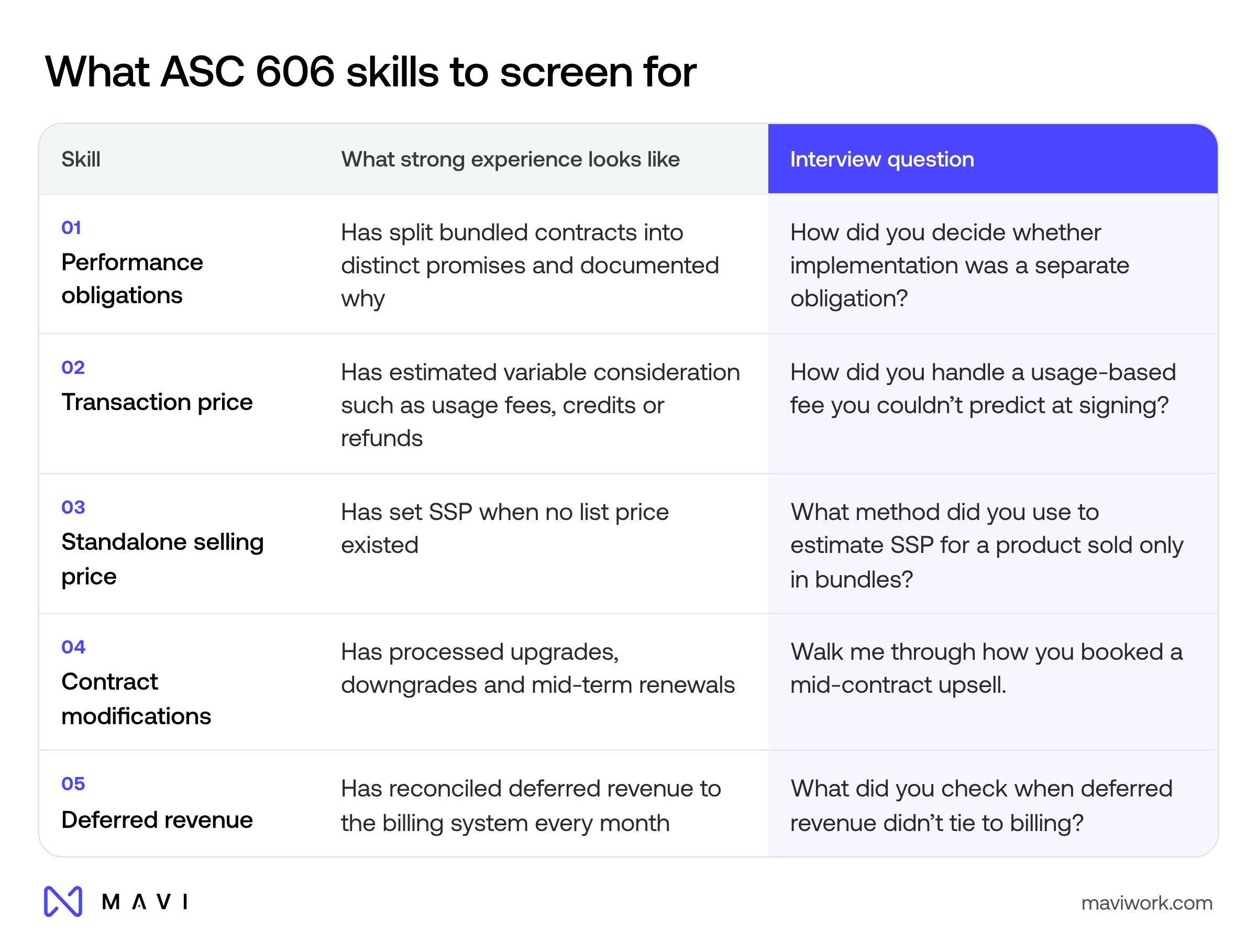
What ASC 606 Skills to Screen For
Resumes list "ASC 606" freely. The table below shows what real experience looks like at each step and a question that separates it from familiarity.
Test Candidates on a Real Contract
The most reliable screen is a short practical exercise. Give candidates a sample contract with a 12-month subscription, a one-time implementation fee and a discount, and ask them to identify the performance obligations, allocate the price using standalone selling prices and build a monthly revenue waterfall with the matching deferred revenue balance.
Give them about an hour and ask them to explain their reasoning out loud. Strong candidates state their assumptions, flag where they would need more information and know which judgments an auditor will challenge. Weak candidates jump straight to a number.
Confirm the Tools They Have Used
Revenue recognition runs through software, so system experience matters as much as the standard itself. On NetSuite, Advanced Revenue Management handles revenue arrangements, allocation by fair value and recognition rules once it is configured correctly (Zone & Co, 2026).
Ask whether the candidate has maintained revenue rules, fixed allocation errors or rebuilt schedules after a contract change. Our guide to the best places to hire NetSuite accountants covers where to find that experience.
Set Up the First 30 Days
Even an experienced hire needs your contracts and policies before they can own revenue. Start with a contract inventory that lists every active customer agreement, its pricing model and any non-standard terms, then share your written revenue recognition policy and the judgments behind it.
In the second and third weeks, have the new hire review the revenue rules in your ERP against that policy and reconcile deferred revenue to billing for the most recent quarter. Gaps found here are far cheaper to fix than gaps an auditor finds.
By the end of the first month, they should run the revenue close with the controller reviewing, and own it outright from the second month.
Where to Find a Revenue Accountant Who Knows ASC 606
A US search through a recruiter brings strong candidates at US salary levels and usually takes several weeks. Contract staffing fills the seat faster, but the person often rolls off before the next audit, taking the knowledge of your revenue rules with them.
A dedicated global hire offers a third option. Pre-vetted platforms test technical accounting before you see a profile, which shortens the search and keeps one person on your revenue schedules every month. Our guide to the best places to hire SaaS accountants compares the main channels.
Hire a Revenue Accountant in Days With MAVI
MAVI places pre-vetted global accountants with SaaS and revenue recognition experience, typically in as fast as 5 days. Every engagement starts with a 14-day risk-free trial, so you can see their work on your own contracts before you commit.
Only the top 2% of applicants pass MAVI's vetting process, which tests technical accounting before a profile reaches you. Companies typically save 50%+ compared with an equivalent US hire, with a minimum 50% overlap with US hours.
The role covers reviewing customer contracts, identifying performance obligations, allocating the transaction price, building revenue schedules and reconciling deferred revenue each month. It also means documenting the judgments auditors will test.
How do you test a candidate's ASC 606 knowledge?
Give candidates a sample contract with several elements, such as a subscription, implementation services and a discount, and ask them to walk through the five steps, allocate the price and build a revenue waterfall. The quality of their reasoning matters more than the final number.
Does the role need NetSuite experience?
It depends on your stack. Companies on NetSuite benefit from candidates who have configured or maintained Advanced Revenue Management, because it automates allocation and revenue schedules once the rules are set correctly.
How fast can I hire a revenue accountant?
Traditional searches often take several weeks. MAVI typically places pre-vetted global accountants in as fast as 5 days, with a 14-day risk-free trial before you commit.