Global Accounting Talent vs. US Hiring: A Cost and Quality Comparison (2026)
This is a data-driven comparison of global accounting talent vs. US hiring across cost, quality, speed, and operational fit to help CFOs, Controllers, and finance leaders make an informed decision.
Written by
MAVI
Published On
May 21, 2026
The question every CFO is asking: can global accounting talent match the quality of a US hire and deliver it at a fraction of the cost?
For most fast-growing companies in 2026, the answer is yes – but only when global talent is sourced from the right platform, vetted rigorously, and integrated correctly. The distinction between high-quality global accounting talent and the low-quality global models that have given the category a poor reputation is enormous.
The US Accounting Talent Market
The assumption that US hiring is the default for US companies is increasingly hard to justify economically.
Supply is shrinking
The number of new CPA exam takers has declined for multiple consecutive years according to the AICPA, contracting the pipeline of experienced, mid-level accounting professionals at the exact moment demand is growing.
Costs have escalated
A Senior Accountant in a major US market now commands $90,000–$130,000 in base salary, plus $25,000–$40,000 in benefits and payroll taxes, plus $15,000–$25,000 in recruiting fees through a traditional channel. Total first-year cost: $130,000–$195,000+.
Timelines are long
The average mid-level accounting search takes two to four months even with a recruiter engaged. For companies with urgent needs, this is a structural problem that doesn't resolve itself.
Quality is variable
Even after paying a premium, quality isn't guaranteed. Accounting managers consistently report receiving poorly screened candidates from traditional recruiters – driving significant hiring manager time and a meaningful rate of failed hires.
The Global Accounting Talent Opportunity
The global accounting talent market has matured significantly. A large cohort of experienced accounting professionals – trained in international standards, deeply familiar with US GAAP, and experienced working directly with US companies – is now available through the right channels.
These are not junior data entry workers. They are mid-level and senior professionals with Big 4 experience, CPA or equivalent international credentials, five to ten-plus years of hands-on accounting experience, deep proficiency in US tools (NetSuite, QuickBooks Online, Bill.com, Ramp, Expensify, Stripe), and a track record working with US companies in fast-paced environments.
The cost difference is structural, not a signal of lower quality. Equivalent talent costs significantly less in global markets because labor markets differ – not because the work is inferior. MAVI's global talent delivers at 50–70% less than US equivalents through a vetting process that admits only the top 2% of applicants.
Cost Comparison: US Hire vs. Global Hire Through MAVI
Mid-Level Senior Accountant (5–7 Years Experience)
The savings are not marginal. For a company with three accounting team members, the annual savings from MAVI's global talent model vs. equivalent US hires can exceed $200,000 per year without sacrificing accounting quality.
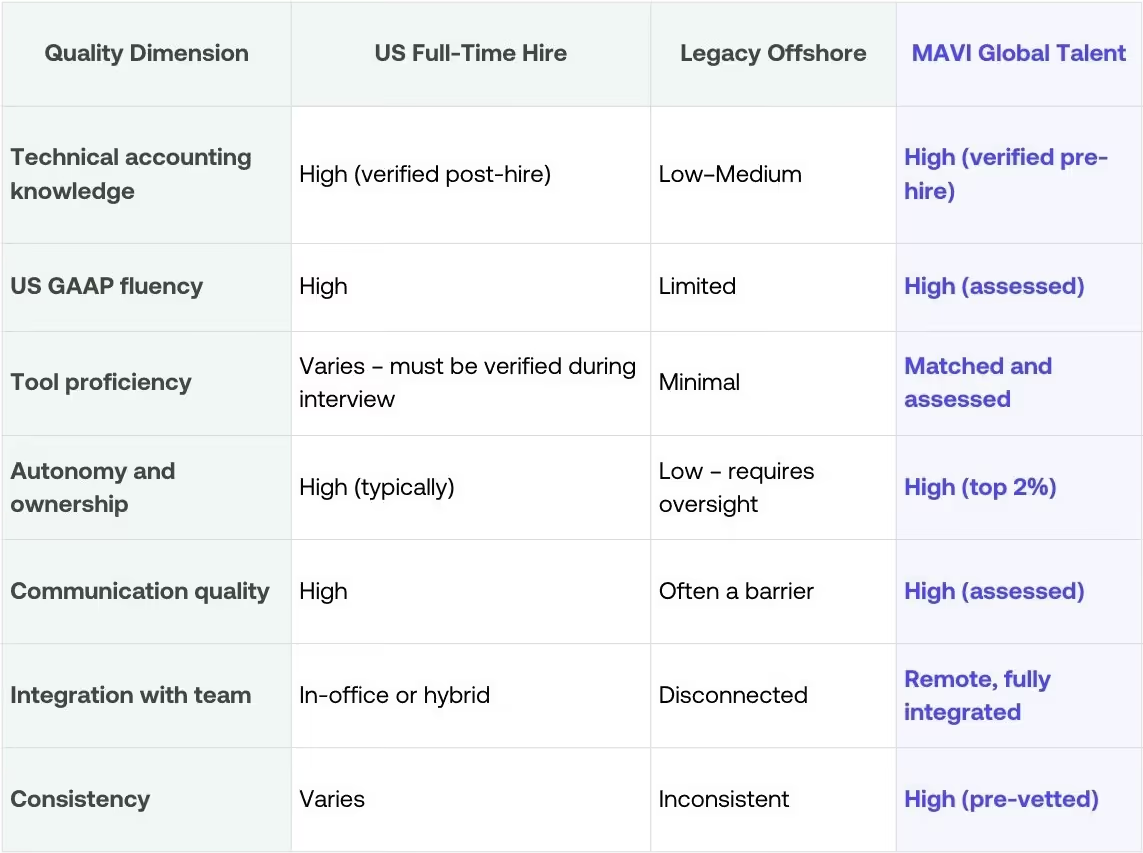
Quality Comparison: What "US-Caliber" Actually Means
The quality of global accounting talent varies enormously by sourcing channel.
Legacy offshore staffing agencies typically deliver junior-level talent with limited US GAAP knowledge, minimal tool proficiency, and significant oversight requirements. Not integrated into the client's team – operating as an isolated offshore unit. Accounting managers who try this model often find that the oversight cost eliminates the savings, and the output quality creates new problems.
MAVI's vetting process is designed to solve this. Every candidate admitted has passed:
Technical accounting assessment: US GAAP knowledge, core accounting processes (month-end close, reconciliations, AR/AP workflows), and financial reporting standards. Skills assessment, not resume review.
Tool proficiency verification: Assessed on specific tools and matched to client requirements. A candidate who claims NetSuite experience but can't articulate the close workflow in that system doesn't pass.
Communication and autonomy evaluation: Written and verbal communication, proactive flagging behavior, and the ability to work without constant supervision.
Professional background verification: Credentials, work history, and references verified during intake.
Only 2% of applicants pass all four stages. "US-caliber" means verified ability to perform at the standard US companies require.
Quality Comparison Table
Real Performance: What MAVI Clients Observe
The most consistent theme across MAVI client testimonials is that global talent placed through MAVI performs at a level that exceeds expectations – not just compared to offshore alternatives, but compared to US-based hires and traditional staffing solutions.
Filaments: Co-founder Joel Johnson deployed MAVI talent across multiple client engagements. His assessment of quality was unambiguous: "I would say that there was no sacrifice to achieve the cost savings. I think that I am getting higher quality work with people that I really enjoy communicating with and working with." He trusted MAVI talent to communicate directly with clients – a level of confidence rarely extended to offshore contractors.
Athena Club: Accounting Manager Tushara had hesitations about working with international talent for the first time, coming from a background of using temp staffing. The MAVI Senior Accountant built reconciliations from scratch, streamlined processes, and performed at a level above what the team expected. "I honestly don't know where we would be without her."
Public.com: Finance leadership observed that MAVI's global talent significantly outperformed previous US-sourced contractors on both quality and autonomy: "Very polished, putting out good output instead of other contractors we've worked with who you need to guide, adding more work for us internally."
When Global Talent Is the Right Choice
US hiring makes more sense when the role requires full-time on-site presence in a specific location, when there's a strict domestic hiring policy, or when US residency is required for regulatory or security clearance reasons.
Global accounting talent through MAVI works best when cost efficiency is a priority, when five-day placement versus a two-to-four-month search is operationally meaningful, when the role is remote-compatible, and when mid-to-senior level expertise is what's needed – full-time or fractional. MAVI supports part-time and fractional arrangements in ways that US hiring rarely does economically. Book a call to hire pre-vetted, US-caliber global finance and accounting talent through MAVI.
Frequently Asked Questions
Is global accounting talent through MAVI actually as good as US hires?
Based on client feedback across dozens of placements, yes – often better. MAVI's vetting standard is more rigorous than most US hiring processes. The result is talent that performs autonomously, communicates clearly, and owns processes without creating oversight burden.
What are the cost savings vs. a US hire?
50–70% less all-in – including the talent rate, elimination of benefits costs, no recruiting fees, and minimal vacancy period due to five-day placement.
Does MAVI's global talent know US GAAP?
Yes. US GAAP fluency is a requirement for admission to the network and is assessed during vetting. MAVI talent has direct experience applying US accounting standards with US companies.
How is MAVI different from a traditional offshore accounting provider?
Legacy offshore providers deliver low-cost, low-skill talent requiring constant oversight. MAVI delivers top-2%-vetted professionals who work as integrated team members, own their processes autonomously, and communicate in your channels. The cost savings are similar. The quality difference is significant.
Can I hire global accounting talent part-time through MAVI?

.avif)