Finance's Value Is Moving From Building Models to Judging Them
Elite modellers ranked defining a model's purpose as most human-critical and building it as least. Here's why hiring a US GAAP certified accountant for judgment now matters more than build speed.
Written by
MAVI
Published On
September 2, 2026
The most experienced financial modellers in the world just ranked the phases of their own work by which ones most need a human, and the result quietly redraws what a valuable finance hire looks like. When the Financial Modeling Institute's Global Leaders Council ranked the six phases of the modelling lifecycle, they put Scope first and Build last. Defining what a model should do ranked as the most human-critical task. Actually constructing it ranked dead last.
That single ranking captures a shift every finance leader should be planning around. The value of a finance professional is migrating away from mechanical construction and toward judgment: defining the problem, setting the assumptions, interpreting the output, and standing behind the conclusion. If your hiring criteria still reward the person who builds fastest, you're optimizing for the exact skill AI is absorbing.
Scope First, Build Last
The numbers are striking. 63% of the Council ranked Scope, the work of defining a model's purpose, users, and the decisions it supports, as the single most critical phase for human expertise. Only one member out of 63 ranked Build, the construction phase, in the top position. On the average-rank scale, Scope came first at 1.81 and Build came last at 4.86.
The logic is clear: building a model has traditionally been how professionals developed their understanding of a business, but the construction itself is increasingly mechanical, and that's precisely where AI is most capable. What can't be automated is the judgment that surrounds the build: knowing what the model needs to answer, which assumptions are defensible, and what the output actually means for the decision at hand. As one Council member put it, treating model construction as a mechanical task to be delegated and done as cheaply as possible is to miss the point entirely.
For anyone who needs to hire accounting talent, this reframes the whole evaluation. The candidate who can rapidly assemble a clean model is useful, but that's the commoditizing skill. The candidate who understands why the model exists and can defend its logic to a board is the one whose value is rising. A US GAAP certified accountant who brings that judgment, not just technical assembly speed, is exactly the profile the data says to prioritize.
The Skills That Will Actually Differentiate
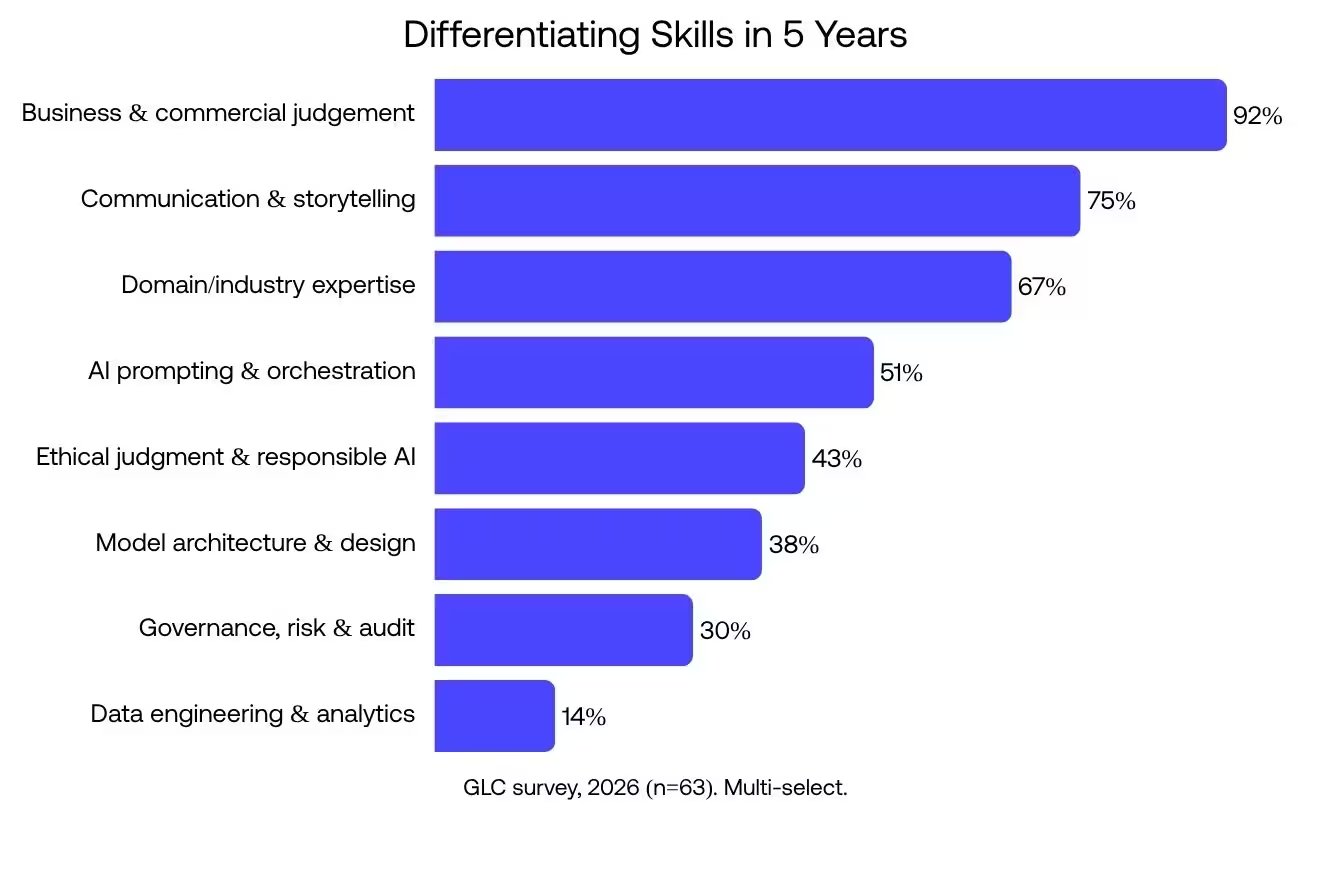
The Council was explicit about which skills will set elite professionals apart over the next five years, and the ranking reinforces the point. Business and commercial judgment topped the list at 92%. Communication and storytelling followed at 75%. Domain and industry expertise came in at 67%. These are the three highest-value skills, and none of them can be automated, outsourced to an algorithm, or produced through prompt engineering.
Notably, technical and tooling skills ranked lower. AI prompting and orchestration sat at the midpoint (51%), which the report reads as a sign these are becoming baseline expectations rather than differentiators, the way spreadsheet proficiency once was. Data engineering ranked last at 14%. The Council does not see the future finance professional as a technologist who happens to work in finance. They see a business thinker who happens to use models.
This is the hiring signal. When you set out to hire accounting talent for a team that will increasingly work alongside AI, the differentiators to screen for are judgment, communication, and domain depth, not raw mechanical fluency. A US GAAP certified accountant who can interpret results, explain them credibly, and apply technical standards with judgment is worth far more than one who can only execute. The former is what the market will pay a premium for. The latter is what AI is steadily commoditizing.
What This Means for Who You Hire
The strategic implication is direct. If the value of finance work is moving from construction to judgment, your hiring criteria have to move with it. Screening primarily for how fast someone can build is screening for the skill with the shortest remaining shelf life. Screening for judgment, technical fluency applied with discernment, and the ability to own a conclusion is screening for durable value.
That's a harder profile to source, because it can't be reduced to a skills checklist and it doesn't turn up reliably through conventional hiring channels. It requires actually assessing judgment and technical depth before a candidate ever reaches you. This is where a pre-vetted talent pool changes the equation: rather than filtering for mechanical ability and hoping judgment follows, you can hire accounting talent that's already been screened for the qualities the FMI data identifies as most valuable. Sourcing a US GAAP certified accountant with proven judgment from a wider, pre-vetted pool lets you build for where finance is heading rather than where it's been. The Council drew a clear map: construction is becoming a machine task, and judgment is becoming the human premium. The teams that hire accounting talent against that map will be the ones staffed for the next decade, not the last one.
What did the FMI survey find about the financial modelling lifecycle?
The Financial Modeling Institute's Global Leaders Council ranked the six phases of modelling by how critical human expertise is to each. Scope (defining the model's purpose) ranked most critical at an average of 1.81, while Build (construction) ranked least critical at 4.86. 63% ranked Scope as the single most critical phase; only one member ranked Build first.
What does "value moving from construction to judgment" mean for hiring?
It means the mechanical work of building models is increasingly handled by AI, while the judgment work, defining scope, setting assumptions, interpreting results, remains human and rising in value. When companies hire accounting talent, the differentiator is shifting from build speed to judgment and interpretation.
Which skills will differentiate top finance professionals?
The Council ranked business and commercial judgment highest at 92%, followed by communication and storytelling at 75% and domain expertise at 67%. Technical tooling skills ranked lower, suggesting AI fluency is becoming a baseline expectation rather than a differentiator.
Why prioritize a US GAAP certified accountant with judgment over build speed?
Because build speed is the skill AI is commoditizing fastest, while applying technical standards like US GAAP with judgment is not. A US GAAP certified accountant who can interpret and defend the numbers delivers the durable value the FMI data identifies, rather than the mechanical assembly AI increasingly handles.
How can companies hire for judgment rather than just technical skill?
Judgment is hard to assess from a resume, so it helps to work with a pre-vetted talent pool where candidates are screened for it upfront. This lets companies hire accounting talent evaluated for judgment, communication, and applied technical depth, rather than filtering only for mechanical ability.